The One Thing I Couldn't Plan For
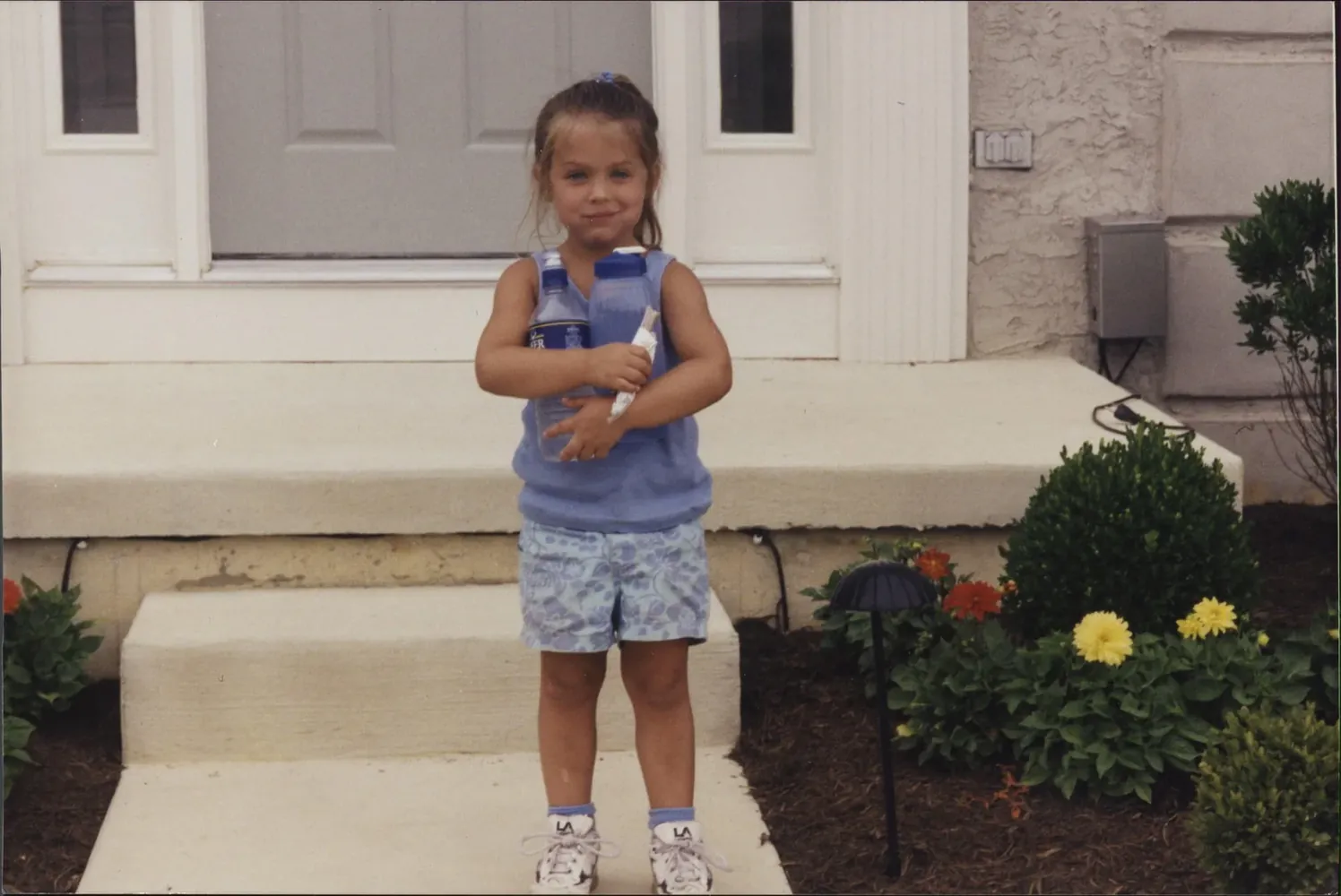
Here is a photo of me that recently surfaced. I'm maybe four or five years old, two water bottles clutched to my chest and a cowtail tucked in like I'd negotiated it into the lineup somehow. The look on my face isn't a big grin. It's quieter than that. It's the look of a kid who has absolutely no doubt about herself.
My parents could tell you more about that little girl than I can. They dressed me in jeans that were always a little too tight and white tank tops, my belly hanging over the waistband, completely unbothered. On weekends I'd climb into my dad's truck and go to work with him, he runs a landscaping business, and he'd hand me jobs that no other kid my age was doing. Sending invoices, filling out bank deposit slips, finding the Phillips screwdriver in the toolbox and handing it over without being asked twice. My parents treated me like I was capable before I even knew what capable meant, and I absorbed every bit of it.
I climbed trees. I did the monkey bars. I went off the high dive. I didn't care about getting dirty. My parents and Aunt TT will tell you I was fearless.
Ask my friends today, the ones who stood next to me at my wedding, and you'll hear similar but sharper words: ambitious, confident, hard working. Type A, if we're being generous. Control freak, if we're being honest. I've built a career and a life around being the person who has a plan and executes it, someone you can depend on.
The more I've sat with that, the more I think it's not really about ambition. It's about control. I like routine. It takes me time to settle into change I didn't choose.
I grew up believing, completely and without question, that hard work was the answer to everything. That if you wanted something badly enough and put in the effort, you would get it. My dad showed me that, Saturday after Saturday, from the passenger seat of his truck.
I had never been given a real reason to believe otherwise.
Until IVF.
Meeting Charlie
When I met Charlie, I was introduced to Cystic Fibrosis pretty quickly. It wasn't something people brought up in front of him, but everyone who knew him knew. Mornings and evenings meant an hour of treatments: a vest, a nebulizer with antibiotics, and enzymes with every meal. Cystic Fibrosis was always present.
About six months into our relationship, Trikafta came out. I watched it change Charlie's life in real time. He coughed less and you could tell he just felt better. The grueling treatment schedule that had defined his days started to lift. I had never heard of Cystic Fibrosis before I met him, and now I was watching a drug give Charlie a different kind of future.
As time went on, I learned more about what Cystic Fibrosis really means: the progression, the life expectancy, the weight of it. It was scary, and honestly it still is.
We knew our path to kids would lead through IVF because of Charlie's Cystic Fibrosis. We talked about it the way I talk about most things in my life: as a plan we could execute. A series of steps to learn, a process to work through, something I could get good at if I just prepared enough. When I got my job at Google and learned of the additional fertility benefits, we were genuinely so excited.
I wasn't scared. I didn't know what I know now, and that's probably a good thing, looking back. I had never known anyone who had been through IVF personally, but it had been around for decades. People did it all the time. Our first fertility doctor told us early on that there was no reason to believe it wouldn't work for us. I remember feeling like this was just another thing to prepare for, another process to learn, another checklist to work through. I'd do the research, figure out the steps, and put in the effort.
What I Didn't Know
We started our first official IVF cycle in September 2025. By then we'd already been on this road for a year, but that fall was when it really began. What followed became the hardest year of my life.
I won't share every clinical detail here. That's another blog, for another day, with all the numbers and timelines and things I wish someone had told me before we started. But I want to tell you what it felt like because that's the part I wasn't prepared for.
I stopped feeling like myself. For more than a year. The confident version of me felt very far away.
Underneath all of it, there's always been a constant, quiet hum, one I've felt for as long as I can remember: a fear of disappointing people. But I hold myself to an even higher standard than I hold anyone else. Disappointing someone else is hard. Disappointing myself is so much worse. And for the first time in my life, I couldn't plan my way out of it.
The injections I got used to. In parking lots, in hotels, on airplanes, I figured it out. I became someone who carries medication, needles, and alcohol swabs everywhere. But the hormones didn't stop just because I'd mastered the logistics. They moved through me. The headaches, the exhaustion, the anxiety, the bloating, the weight gain, the rage that would show up out of nowhere, the moods that didn't feel like mine. I've always been a little bit intense, but this was something else entirely. I didn't know what my baseline even was anymore.
We went through cycle after cycle. Fresh transfers. Frozen transfers. Each one carrying everything. After our third failed embryo transfer, I just couldn't take it anymore. I cried until I couldn't cry anymore.
In between all of it, I kept trying to find the thing I could control, that I could plan for. I followed a Mediterranean diet. I tried acupuncture. I drank pomegranate juice. I ate tree nuts. I wore warm socks. I got McDonald's french fries after transfer because someone on the internet said so. I did everything I had ever read or been told might help.
It didn't matter. We still didn't get pregnant.
Somewhere in the middle of all of it, Gemini became my closest friend when Charlie was asleep. One in the morning. Three. Five, when I'd finally give up on sleep and start the day. I asked her everything. Interpret these results. What does this follicle count mean? What are my chances this cycle? Why isn't this working? Do I have endometriosis? Why is everyone else getting pregnant and not me? She never had the answer I was actually looking for, but she was always awake, and that counted for something.
I was doing everything right. That fearless girl on the front steps had built her whole life around the idea that effort produces outcomes. But here was something that just didn't work that way, no matter what I did, no matter how tightly I tried to hold on. That was devastating for me.
Why me? Why isn't it working? What do we do now?
A Rainy Weekend in April
I was in a really dark place. I didn't want to talk to anyone. When my mom called to check in and asked how I was doing, I snapped at her (sorry mom). I was horrible. I was broken. I was so, so mad. I had never disappointed myself like this before. I worried about whether I would ever become a mom, whether I would ever feel like myself again, whether the confident girl was just gone.
Around that time, we also switched to a new clinic and a new doctor. She was the one who really started to help bring back some of my hope. It was a little disappointing to feel like we were starting over at square one, but at least we had a new plan, something to work through, with someone we trusted.
Then, slowly, my mood started to stabilize. I'd been off the medications for a little while, and for the first time in months I could think a bit more clearly. One day I asked Charlie a question. What if we started a grant to help other Cystic Fibrosis couples going through this? We kept seeing how expensive it was, cycle after cycle, and we knew other families were facing the same impossible math.
Charlie countered with something bigger. What if we started our own foundation?
The following weekend, it rained. We sat together and we built something. We talked about the name. We played with design ideas and built a website with Claude. We filed for our EIN. We started learning what it actually takes to create a nonprofit. I was excited in a way I hadn't felt in months, checking things off a list together, building something that felt bigger than us, channeling all of that pain into something with a purpose.
By the end of that weekend, we just knew. We were going to take the hardest thing we'd ever been through and turn it into something that helps other Cystic Fibrosis couples. It was all going to be worth it.
Why the Fox Family Foundation Exists
The Fox Family Foundation exists to help families affected by Cystic Fibrosis access IVF. We award grants paid directly to fertility clinics, removing one of the biggest barriers standing between Cystic Fibrosis families and the family they're trying to build.
We built this because so many Cystic Fibrosis couples are now living what we're living. Patients like Charlie are getting healthier. They're living longer, fuller lives, and they're starting to imagine families of their own, something that wasn't really possible until recently. It's a remarkable thing. Building a family through IVF is expensive, and exhausting, and lonely in a way that's hard to describe unless you've sat in that waiting room yourself. We know what it costs, financially, physically, and emotionally. We wanted to make it even a little bit easier for the families coming after us.
Where We Are Now
I want to be clear: we are still in the middle of our own journey. I don't have a happy ending to give you, at least not yet. What I have is this foundation, the hope it's given me, and the certainty that the families we help deserve to know someone is in their corner.
For months, I couldn't have told you what this foundation was giving me. It wasn't exactly purpose. It took me a while to find the words. I think what it gave back was my confidence, a piece of myself I thought I'd lost. For a year, I had worked as hard as I possibly could, and it hadn't gotten us the thing we wanted most. But it didn't produce nothing. We made real progress, even if we aren't pregnant. Then here was this thing I could build, that I could pour myself into, that actually took shape because of the effort I put in. It reminded me that I'm still capable. That I can still do anything I want to do. After so long feeling powerless, building this gave me back a quiet kind of confidence, and a real sense of pride. Something that is ours, that exists because Charlie and I decided it should.
I didn't want to share any of this for a really long time. In the beginning, I told very few people. But as I started to open up, I actually felt a lot better. Once we decided to create the foundation and tell our story, I still planned everything around getting pregnant first. I wanted to wait until I had the perfect ending. That's the perfectionist in me talking. Until I didn't want to wait anymore. I decided we should just get started: start helping people, start telling our story, pregnant or not.
But this whole experience has taught me that control and perfectionism aren't always the answer. They've gotten me a lot of success and things I'm proud of, but I think they've also held me back in ways I'm only starting to understand. Letting people I know, and people I barely know, into the hardest year of my life is scary. I don't want anyone to feel sorry for me, or to treat me differently. But opening up has connected me with people I never would have met otherwise: friends of friends, strangers I connected with because they'd been through something similar. Every one of those connections made me feel a little less alone. It made me feel warm, and hopeful, more like myself again. And that gave me back something I didn't expect: a fulfillment I hadn't felt in a long time. So if telling our story, the real feelings and the real doubts I had about myself, helps even one other person feel a little less alone, then it's worth being uncomfortable.
I'm still learning to let go of control. I'm still figuring out who I am when hard work doesn't guarantee the outcome. I'm still on this journey. But I'm no longer just surviving it. I'm building something with it.